This week: the wild turkey. There were no wild turkeys in Connecticut for about 150 years, and the 35,000 or so here now go back to 22 birds that were netted in New York and released in Canaan in the winter of 1975. The piece below is about how they were caught and how they spread to every town in the state.
The Ledger's Dinner Club meets Thursday in Litchfield, and any seats still open are at litchfield-ledger.dnnr.io.
Patrick
The Litchfield Ledger

The 22 Turkeys Released in Canaan

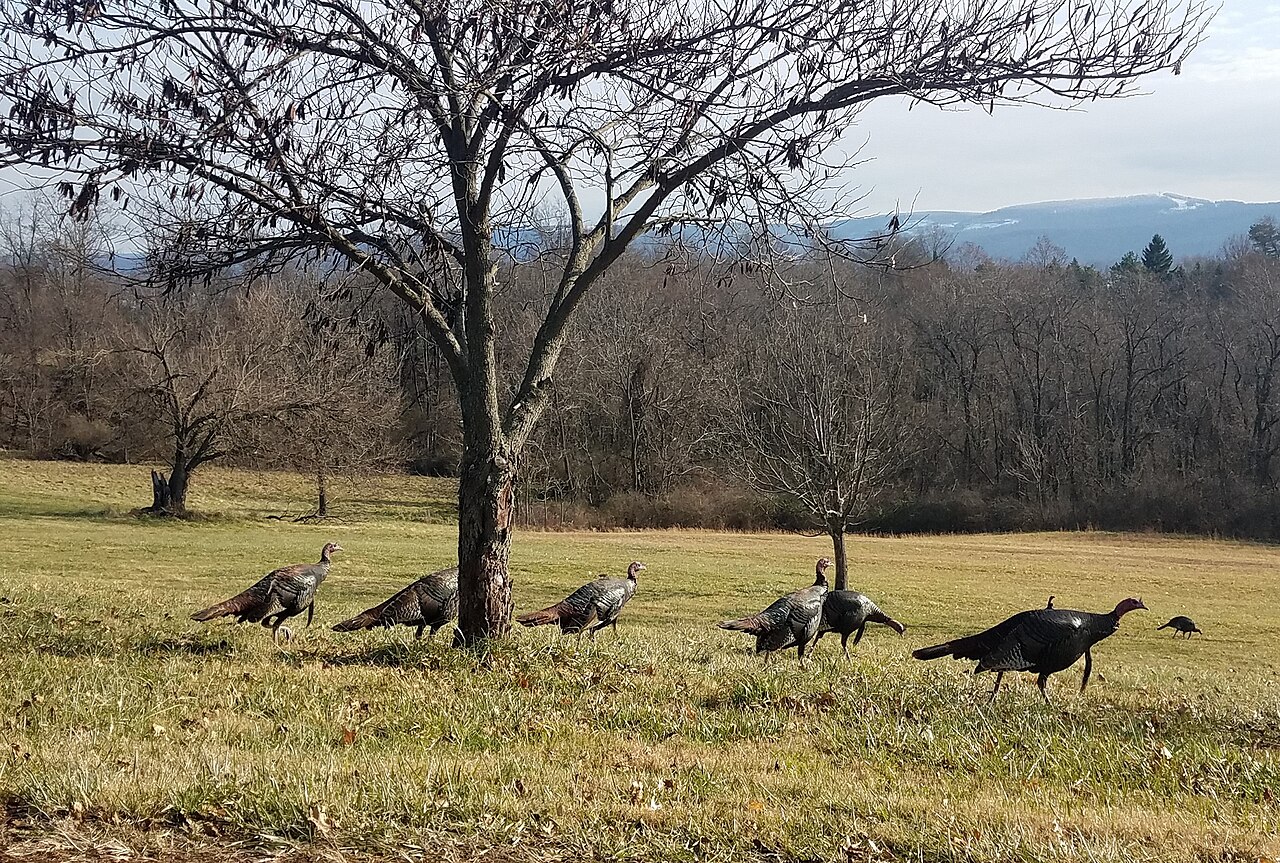
Eastern wild turkeys foraging in Fayette County, Pennsylvania. Sarov702, CC BY-SA 4.0, via Wikimedia Commons.
The wild turkeys now found in all 169 Connecticut towns, about 35,000 of them by the National Wild Turkey Federation's count, trace back to a restoration effort that began with 22 birds brought from New York in the winter of 1975. The first of them were let go in the woods of Great Mountain Forest in Canaan, and for the 150 years or so before that there had been no wild turkeys in the state at all.
Where did the original turkeys go?
The state Department of Energy and Environmental Protection's account is that turkeys were abundant when the first settlers arrived and that two things finished them. The forest was cleared until very little of it was left, and a run of severe winters took the birds that remained, so that by the early 1800s the turkey was gone from Connecticut.
Why didn't the state just raise more?
The state tried that first. From the 1950s into the early 1970s it released turkeys raised in captivity, and the effort largely failed, because a bird reared in a pen does not have the instincts it needs to survive in the woods.
How do you catch a wild turkey?
Biologists use a rocket net. They bait a clearing and wait in a blind some distance off, and when enough birds have gathered they fire three small rockets that carry a large, lightweight net over the flock. Eight hens caught this way at Allegany State Park in western New York were released at Great Mountain Forest on January 28, 1975, under Steve Jackson, the state's first wild turkey biologist, and fourteen more New York birds followed over the course of that winter.
How did 22 become 35,000?
The birds took to the northwest corner, and in 1978 the state began netting turkeys here and moving them to other parts of Connecticut. By 1992, when the program ended, 356 birds had been released at 18 sites, Norfolk among them, and the turkeys spread on their own from there. Hunting reopened in 1981, and between 1987 and 1997 Connecticut had enough turkeys to send 188 of them to Maine, North Carolina, Texas and Louisiana, where they were used to start flocks the same way. The money came in large part from the federal excise tax on firearms and ammunition, which is set aside for wildlife restoration.
What are they doing in November?
They are feeding on acorns and beechnuts under the hardwoods and traveling in the larger flocks that form for the winter. At dusk they fly up into trees to roost, which surprises people who assume a bird that size stays on the ground. A tom weighs 15 to 25 pounds and a hen 8 to 12, and DEEP puts a wild turkey's flying speed at up to 55 miles an hour. The agency also asks people not to feed them, since feeding spreads disease and costs the birds their wild instincts.
Where is it?
Great Mountain Forest covers more than 6,000 acres on the high ground between Norfolk and Falls Village, and its trails are open to the public from gates on Windrow Road in Norfolk and Canaan Mountain Road in Falls Village.

🍁 Wednesday the 11th
Infinity Hall, Norfolk – Jesse Cook. The Toronto guitarist has spent thirty years playing rumba flamenco with a full band behind him, and has ten gold and platinum albums to show for it. Doors open at 7:00. 20 Greenwoods Road West. 8:00 PM HEAR THE GUITAR
🌽 Thursday the 12th
Litchfield Community Center, Litchfield – Evening Glow. Rebecca Patterson, principal cellist of both the Waterbury and New Haven symphonies, plays an hour of duets with violinist Alyce Cognetta Bertz in the monthly afternoon series, and a reception with refreshments follows. Registration is requested. 421 Bantam Road. 3:30 PM – 4:30 PM RESERVE A SEAT
🦃 Friday the 13th
Warner Theatre, Torrington – LeAnn Rimes. Rimes was thirteen when "Blue" came out in 1996 and has been on the road for most of the thirty years since, including a stop at the Warner in April of last year. She plays the Oneglia Auditorium, the big room. 68 Main Street. 7:30 PM GET TICKETS
🍂 Saturday the 14th
Hare Preserve, Cornwall – Introduction to the Hare Preserve. Carlos Neto and Terry Burke of the Cornwall Conservation Trust lead a walk on a trail a little under half a mile long that winds past a pond and the sculptures Monty Hare left in the woods. The footing is uneven and the path is narrow, so dogs need to be on a leash. Parking is off Popple Swamp Road. 10:00 AM WALK THE TRAIL
🥧 Sunday the 15th
Litchfield Community Center, Litchfield – November Song. Wind players from the Waterbury Symphony Orchestra bring two pieces written for small wind ensemble, Gounod's Petite Symphonie and Dvořák's Serenade for Winds, to the orchestra's Litchfield chamber series. Tickets are sold through the symphony. 421 Bantam Road. 4:00 PM HEAR THE WINDS
That is one pick a day. The full list, including the second night of owl banding at Mine Hill on Wednesday and Lou Barlow of Dinosaur Jr. at Cornwall Town Hall on Saturday, is on the website.

The Ledger is on Instagram. Photographs of the county between issues, plus events that don't make the newsletter.


Show your business to thousands of Litchfield locals. Email Patrick at patrick@litchfieldledger.com.