This week: the saw-whet owl. Every November, thousands of owls about the size of a robin pass south through Connecticut after dark, and almost nobody ever sees one. On Saturday night a bander in Roxbury will set nets at Mine Hill and try to catch a few, so the piece below is about what is known about the bird, which is a good deal more than was known thirty years ago.
Patrick
The Litchfield Ledger

The Owl the Size of a Robin

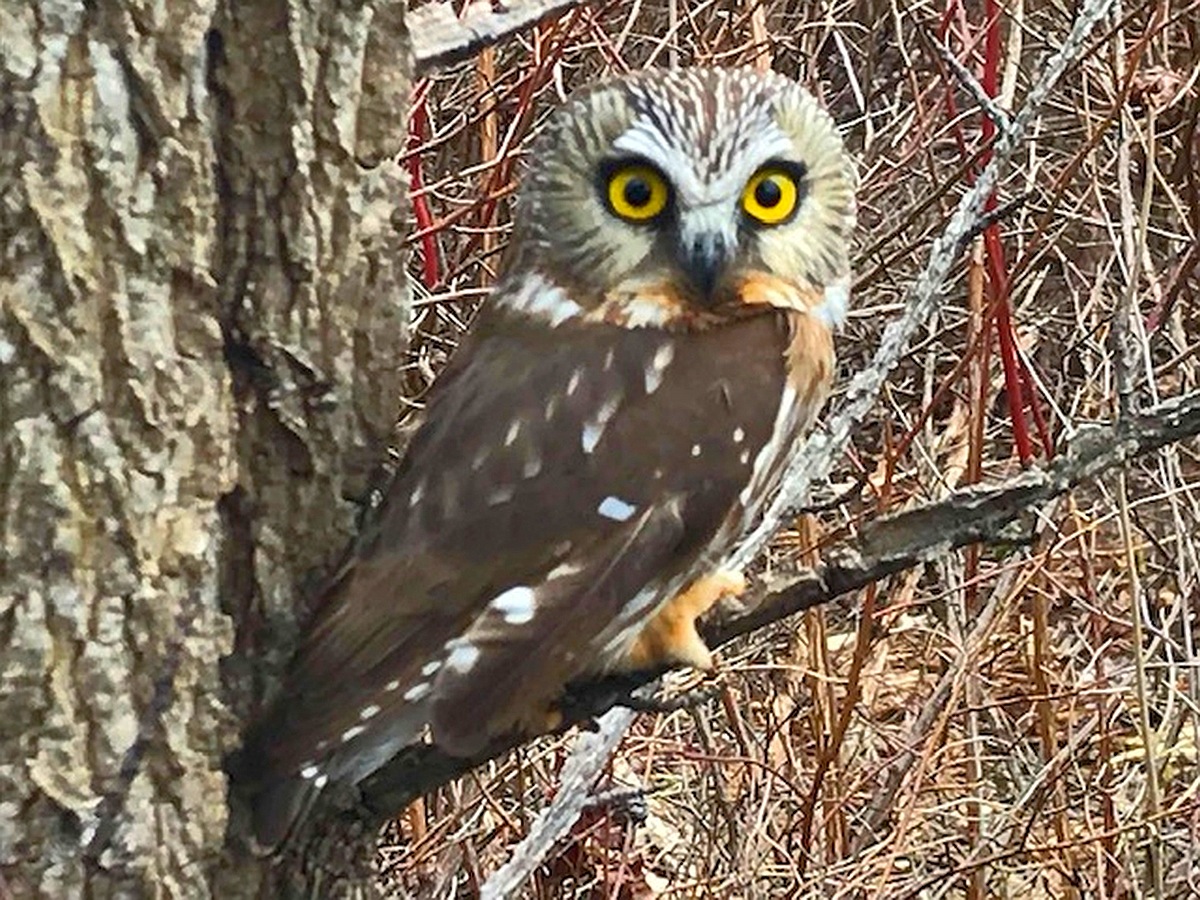
A Northern saw-whet owl at Great Swamp National Wildlife Refuge, New Jersey, February 2019. Dave Miller, U.S. Fish and Wildlife Service.
From mid-October through November, Northern saw-whet owls move south through Connecticut in numbers that would surprise most people who live here, because almost none of them are ever seen. The birds travel after dark, keeping low through the trees, and spend the daylight hours tucked into whatever hemlock or red cedar offers the thickest cover. A saw-whet is about eight inches long and weighs around three ounces, which puts it in the same class as a robin, and it has the habit of sitting motionless when something walks underneath it rather than flying off.
What does it sound like?
The name is supposed to come from one of its calls, a rasping note that early listeners compared to a saw blade being drawn across a whetstone, though the sound most people would recognize is the spring song, a single flat toot repeated roughly twice a second for minutes on end, somewhere near the pitch of a truck backing up. On a still night in March it carries half a mile. By November the birds have gone quiet, and that silence is a large part of why their numbers went unnoticed for so long.
Where do they come from?
Most of them breed in the spruce and fir country that runs across Canada and northern New England and down the high ground of the Appalachians, where they nest in tree cavities, often an old flicker hole, and will readily take a nest box. A few pairs nest in Connecticut, mostly in the hills of the northwest corner, but the bulk of what passes through in fall was hatched well to the north. The size of the flight in any given year depends on the mouse population in those northern woods. When voles and deer mice are abundant the owls raise large broods, and the young birds push south in October looking for territory of their own, which is why banders see a heavy year every few seasons with leaner years in between.
How does anyone catch one?
For most of the last century the saw-whet was listed as rare across much of the East, and its migration was barely understood, until banders began setting fine black mist nets between poles in the woods and playing a recording of the toot call beside them. The owls came in to investigate, sometimes dozens in a single night at a good station. Project Owlnet now ties together more than a hundred banding stations across the United States and Canada, and the bird that had been listed as scarce turned out to be a regular migrant that nobody had been able to see.
A bander checks the nets about once an hour. Each owl taken out gets a numbered aluminum band on one leg, is weighed and measured, and is released at the spot where it was caught, and some of those bands do turn up again, on a bird netted in Pennsylvania the following week or in Ontario the following spring.
How do they tell how old it is?
They hold the wing under a blacklight. New owl feathers carry a pigment called porphyrin that glows pink under ultraviolet light and fades as the feather ages and takes sun, so a bird hatched this summer glows evenly across the entire underside of the wing, while an older bird shows a patchwork of bright new feathers next to dull ones, because adults replace their flight feathers a few at a time over several years. Reading that pattern under the lamp is enough to put an age on the bird.
What do they eat?
Deer mice above all, along with voles and shrews, which the owl hunts from a low perch at the edge of a clearing. A whole mouse is a large meal for a three-ounce bird, so a saw-whet will often eat half and leave the rest cached on a branch. In winter the cached half freezes, and the owl has been observed sitting on it, the way it would sit on an egg, until it thaws enough to eat.
Why don't we see them?
Because they roost low, sometimes at eye level, pressed against the trunk of a hemlock or a cedar, and because their response to a person is to hold still rather than fly. People have been known to lift them off branches by hand. The dependable way to find one in daylight is to look for whitewash on the ground beneath a perch and the pellets of fur and bone that collect with it, or to follow the chickadees and jays, which find roosting owls long before people do and scold until the bird moves on.
Where is the banding?
At Mine Hill Preserve in Roxbury, in the parking lot at 32 Mine Hill Road, on Saturday the 7th and again on Wednesday the 11th, from 7 until 11 PM. Larry Fischer, a federally licensed raptor bander who has worked with saw-whets for more than 25 years, runs the nets and carries each owl back to the lot between checks so people can see it up close. The cost is $10 a person or $25 a family, registration is required through the Roxbury Land Trust, and since the owls are wild there is no promise that any will show up on a given night. Dress warm and bring a chair, a flashlight and something hot to drink.
The preserve was a working iron mine in the 19th century, and the stone furnace still stands in the woods below the road. The nets go up once it is fully dark, and the owls come in low through the trees toward the sound of the recording.

🍁 Wednesday the 4th
Litchfield Community Center, Litchfield – The Power of Pigment. Art historian Jane Oneail on where color came from before it came in tubes, from the purple squeezed out of Mediterranean sea snails to the ultramarine ground from lapis that once cost more than gold, and on how painters have used it to steer the eye. Part of the Culturally Curious lecture series. Free, donations welcome, pre-registration advised. 421 Bantam Road. 3:00 PM – 4:00 PM RESERVE A SEAT
🥃 Thursday the 5th
Kent Memorial Library, Kent – Litchfield Distillery at the library. The Bantam Road distillery brings its bourbon, gin and vodka up to Kent and talks through how it makes them, with samples poured. Free and 21 and over, and the library is now in its new building at 10-12 Landmark Lane on Kent Green. 6:30 PM TASTE THE SPIRITS
🔍️ Friday the 6th
Gunn Memorial Library and Museum, Washington – Washington History Mystery. Nine puzzle stations built around objects from the Gunn Museum's collection, worked through in timed groups, with an arcade of the video games that fourth and fifth graders coded this fall from the same collection. The library closes for the day to set it up. Registration required. 5 Wykeham Road. 5:00 PM – 7:00 PM SOLVE THE MYSTERY
🦉 Saturday the 7th
Mine Hill Preserve, Roxbury – Owl Banding Demo. Larry Fischer nets migrating saw-whet owls after dark and brings them back to the parking lot to be weighed, measured, banded and released, which is the subject of this week's story above. Bring a chair, a flashlight and a hot drink. $10 a person, $25 a family, registration required. Repeats Wednesday the 11th. 32 Mine Hill Road. 7:00 PM – 11:00 PM SEE AN OWL
🍂 Sunday the 8th
Hickory Stick Bookshop, Washington Depot – John Mutter, Fortune and Glass. Mutter co-founded Shelf Awareness and spent twenty years covering bookselling for Publishers Weekly, and after a career spent writing about other people's books he has published a first novel of his own. Talk and signing. 2 Green Hill Road. 3:00 PM MEET THE AUTHOR
That is one pick a day. The full list, including the Hopkins Holiday Market in Warren, the Warren Miller ski film at Mohawk Mountain, and Ginny Apple on the animals that come out after dark at Roxbury Town Hall, is on the website.

The Ledger is on Instagram. Photographs of the county between issues, plus events that don't make the newsletter.


Show your business to thousands of Litchfield locals. Email Patrick at patrick@litchfieldledger.com.